Buddhism - General Category

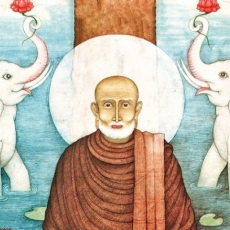
Life of Buddha Shakyamuni

On the eve of Vesakha in 588 BC, while meditating with mind tranquillized and purified, in the first watch of night (6pm-10pm)Siddhartha Śākyamuni developed that supernormal knowledge which enabled him to remember his past lives. In the second watch (10pm-2am), Buddha developed the clairvoyant supernormal vision, which enabled him to see the death and rebirth of beings. In the last watch (2am-6am), he developed the

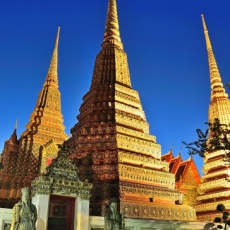
Buddhism in Thailand

The historical origins of Buddhism in the part of mainland Southeast Asia known today as Thailand are obscure: According to popular Thai tradition, Buddhism was propagated in the region south of present-day Bangkok by the monks Sona and Uttara, who were sent to Suvaṇṇabhūmi (the golden land) by the Mauryan king Aśoka in the 3rd century B.C.E. According to this view, Theravāda Buddhism has dominated

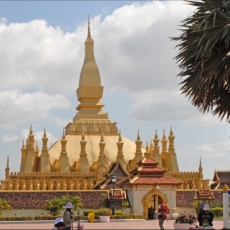
Buddhism in Laos

The primary sources for the history of Buddhism in Laos are texts, such as palm leaf and mulberry leaf manuscripts, stone and metal inscriptions, traveller’s reports, and printed materials: These sources, which are held in monastic, governmental, and royal archives, provide information on Lao Buddhism from only the 14th century and after, and many have yet to receive scholarly scrutiny. Buddhism helped construct Lao identity.
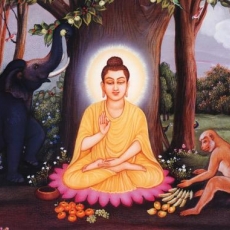
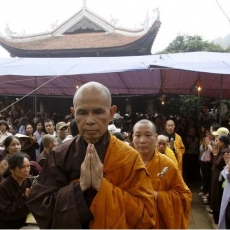
Buddhism in Vietnam

Although both Theravāda and Mahāyāna Buddhism exist in Vietnam, the kind of Buddhism that is most influential and most widely practiced by the majority of Vietnamese Buddhists is Sinitic Mahāyāna Buddhism. Indian and Chinese scholastic traditions have had little if any impact, while Chinese Chan and Pure Land are the only major schools that provide philosophical and religious foundations for the ideas and practices of

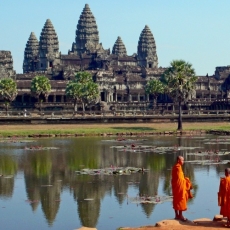
Buddhism in Cambodia

Cambodia in the 21st century understands itself as a Theravāda Buddhist nation: While this self-conscious identification as a Theravāda nation is fairly recent, the history and development of Buddhism in the region that constitutes present-day Cambodia extend back nearly two millennia: During this time numerous transformations occurred and Khmer Buddhism today is different from Khmer Buddhism even 2 centuries ago, before the rise of modern

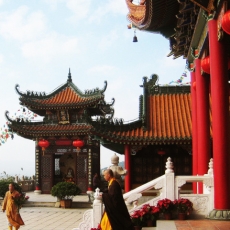
Buddhism in China

During its long history in China, which spans nearly 20 centuries, Buddhism developed flourishing traditions, exerted far-reaching influence on intellectual and religious life, and left its mark on virtually all aspects of Chinese society and culture. By that time Buddhism had already establish a strong presence within the Central Asian kingdoms that controlled most of the trade along the Silk Road.

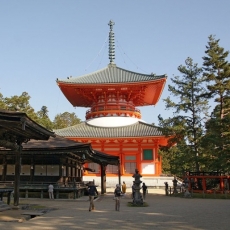
Buddhism in Japan

Buddhism in contemporary Japan exhibits several distinctive characteristics: In a country that sometimes prides itself on having achieved a secular society, the Buddhist religion often seems marginal to contemporary Japanese culture. Yet surveys reveal that a large majority (roughly 75%) identifies itself as Buddhist. In institutional terms, Japanese Buddhism is simply the sum of its denominations, and being a Buddhist means being a member of

Ālaya-Vijñāna | Storehouse Consciousness

Ālaya-Vijñāna is the Sanskrit term denoting, roughly, “storehouse” consciousness, a conception of unconscious mental processes developed by the Yogācāra school of Indian Buddhism in the 3-5th centuries CE. Ālaya-Vijñāna appears in such “Yogācāra” scriptures as the Saṁdhi-nirmocana Sūtra and the Laṅkāvatāra Sūtra, but is most systematically treated in the scholastic treatises of Asaṅga (c. 315-390) and Vasubandhu (c. mid-4th to mid-5th centuries).

Arhat in Theravada Buddhism

*/ 1. Arhat The Sanskrit term Arhat (Pāli, Arahant ) derives from the root arh ( Arhati ) and literally means “ worthy ” or “ deserving .” The term is especially important in Theravāda Buddhism , where it denotes the highest state of spiritual development, but it also has pre-Buddhist and non-Buddhist applications. 2. History and Development of the Term In Vedic and non-Vedic

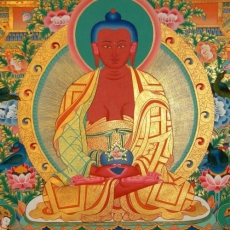
Devotion to Amitābha

Amitābha (“immeasurable light”), or Amitāyus (“immeasurable lifespan”), are the Sanskrit names of a Buddha who in Mahāyāna Buddhism is represented as the supernatural ruler of “the Land of Bliss” (Sukhāvatī), a paradise-like world in the Western part of the universe. According to the doctrine associated with his name and commonly called Amidism (from the Japanese form, Amida), he is a superhuman saviour. Amitābha belongs wholly

Pages